
Clark County Criminal Case Files
Clark County criminal case files are kept by the Clerk of the District Court at the courthouse in Ashland. District court criminal records can include felony, misdemeanor, traffic, fish and game, appearance bond, diversion, sentence, probation, and expungement activity. The full case file is broader than the charge record. Charges explain what was filed. The criminal case file tracks arraignment, pleas, motions, hearings, bond, trial settings, disposition, sentence, and post-case activity.
The County Attorney's Office is at 913 Highland, Ashland, KS 67831, phone 620-635-2828. Clay Kuhns is listed as Clark County Attorney, with Brooke Sanchez as secretary. The county attorney is the local prosecuting office for many misdemeanor and felony matters filed in district court. Criminal defendants who cannot afford counsel should ask the district court about appointed-counsel procedures at first appearance or arraignment.
The Clark County Attorney page is the source represented in this image.
That office is part of the criminal case path, but case records and certified copies remain a District Court clerk function.
Clark County Criminal Case Flow
Clark County is in the 16th Judicial District. The county Judges page states district magistrate judges handle misdemeanor trials, traffic, wildlife and parks citations, tobacco infractions, protection orders, and felony cases through arraignment. Decisions of district magistrate judges may be appealed within the district court to a district judge. Appeals from district judges go to the Kansas Court of Appeals or Kansas Supreme Court depending on statute and case type.
- Charges filed: A complaint or other charging document opens the court case after investigation, citation, or arrest.
- First appearance and arraignment: The court addresses the charge, counsel, bond, and plea stage.
- Pretrial activity: Motions, discovery, diversion, bond reviews, and hearing settings appear on the docket.
- Plea or trial: The case resolves by plea, dismissal, trial verdict, or other court-approved disposition.
- Disposition and sentencing: The docket and journal entry show the outcome, sentence, costs, probation, restitution, or custody terms.
- Post-case activity: Expungement, probation matters, warrants, collections, or appeals may appear later.
For charge-focused details after an arrest, use the court charge record path rather than treating the full criminal case file as a booking log. The full case outcome belongs in the Clark County criminal court record, while arrest custody status belongs to jail and VINE channels.
Clark County Criminal Record Fields
A public criminal court record may show the case number, charge, severity, court, judge or magistrate, defendant, attorney, prosecutor, bond, hearings, plea, motions, disposition, sentence, probation, fines, costs, restitution, and expungement entries. Some details may be redacted or withheld under court rules, especially when juvenile, sealed, expunged, victim-sensitive, or protected personal information is involved.
| Field | What It Shows |
|---|---|
| Case number | The district court identifier used for docket tracking, payments, and copy requests. |
| Charge | The offense filed in court, which may later be amended, reduced, dismissed, or resolved by plea or verdict. |
| Arraignment | The hearing stage where the charge and plea are addressed. |
| Bond | Release terms, surety, recognizance, or financial conditions when public. |
| Disposition | The outcome of each charge or case, such as guilty plea, dismissal, acquittal, diversion, or conviction. |
| Sentence | Jail, probation, fines, costs, restitution, or other court-ordered terms. |
| Expungement | Post-case activity that may limit public access after a court order. |
Clark County Charges vs Convictions
A charge is an allegation filed in court. A conviction is an outcome after a guilty plea, guilty verdict, or qualifying finding. A criminal court record may show both. It may also show that a charge was amended, reduced, dismissed, diverted, or resolved in a way that did not become a conviction. This distinction matters for record reading, employment licensing, housing screening, and expungement review.
| Point | Charge | Conviction |
|---|---|---|
| Meaning | Offense filed by complaint, information, indictment, or citation. | Final criminal outcome after plea, verdict, or qualifying judgment. |
| Where seen | Charging document and docket entries. | Disposition, journal entry, sentence, and criminal-history reporting where applicable. |
| Can change | May be amended, reduced, dismissed, or dropped. | May later be appealed, modified, or expunged if eligible. |
| Search caution | Does not prove guilt by itself. | Shows a court outcome, but read sentence and expungement status too. |
The Clark County Sheriff page is linked to criminal records because law-enforcement events may begin the path to charges.
Sheriff activity may produce arrest or incident records, but the court case file starts when charges are filed in court.
Search Clark County Criminal Records
Search public district court criminal records through Kansas CaseSearch first, then contact the Clark County Clerk of the District Court if the record is not online. The clerk's phone is 620-635-2753. Use the case number if known. For traffic and criminal payments, the county District Court page links to the Kansas courts online payment system and also provides the Centralized Court Payment Center mailing route at CCPC, PO Box 750200, Topeka, KS 66675-0200.
Do not confuse a court case search with a statewide criminal-history check. The Kansas criminal history search is a KBI route for public criminal-history information, while the district court file is the court's own case record. The KBI registered offender search is another separate resource for offender registration, not a complete Clark County court docket.
The manifest image below comes from the Kansas criminal history search source.
KBI history, court files, sheriff reports, and jail custody tools answer different questions and should be checked through their own official channels.
Clark County Sheriff Report Context
Some criminal matters begin with sheriff reports. The sheriff services page says report requests should include the case number when possible and payment must be received before release. Reports can be delivered by USPS, fax, email, or pickup, but reports with pictures can only be mailed. The sheriff does not take debit or credit cards for these report requests.
| Sheriff Record Item | Amount or Rule |
|---|---|
| Report copy | $5 per copy |
| Report with pictures | $15 per copy if pictures are available |
| Research labor | $17 per hour when research is needed |
| Postage for pictures | $3 postage for reports with pictures |
| Payment method | Check or money order before release; no debit or credit cards |
The Clark County sheriff services page is the source for report and service fees.
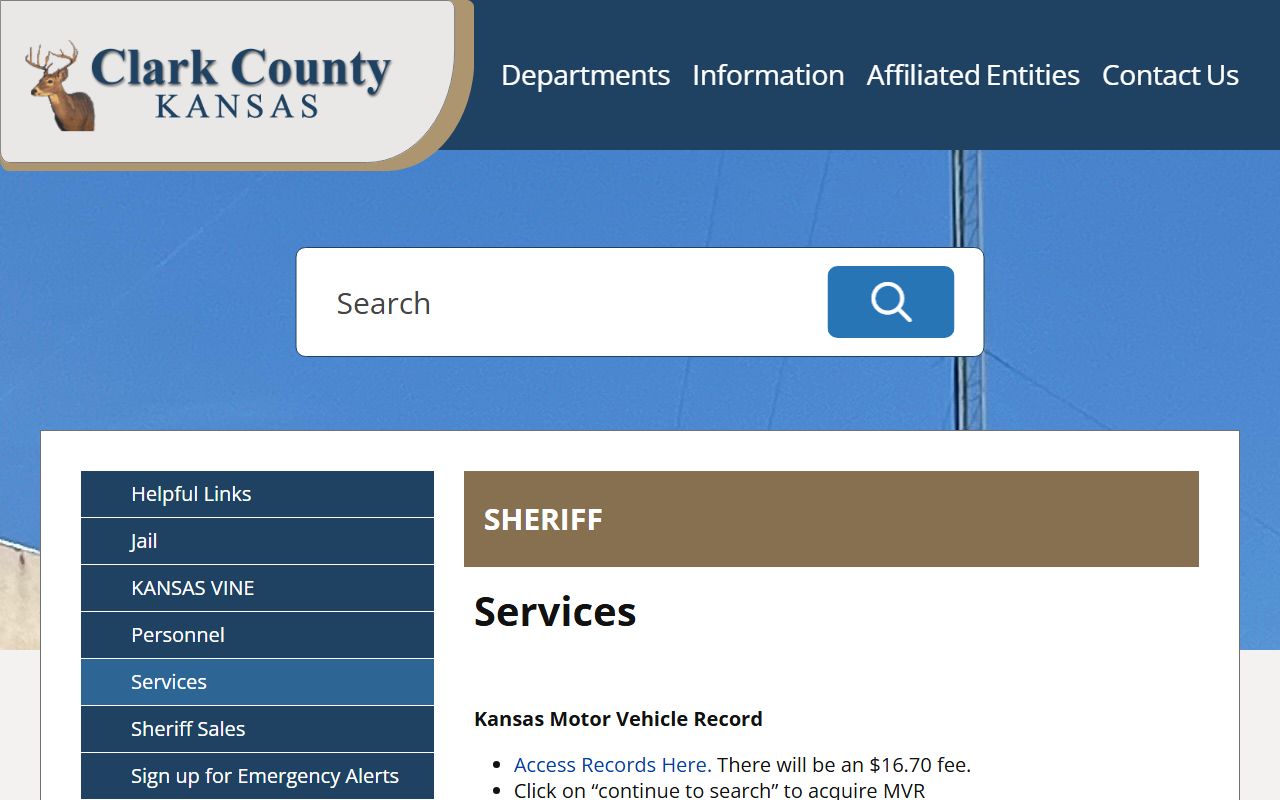
Those fees apply to sheriff records, not to District Court certified copy fees or docket fees.
Sealed Clark County Criminal Records
Juvenile records, sealed records, expunged records, protected addresses, victim-sensitive information, and some personal identifiers can be withheld or redacted. Kansas Rule 22 controls public electronic access to district and appellate case records. Kansas open-records law also contains exceptions for records that are not required to be disclosed.
| Point | Sealed Record | Expunged Record |
|---|---|---|
| How access changes | Closed or limited by court order or statute. | Public access is limited after an expungement order if statutory requirements are met. |
| Common source | Juvenile, adoption-related, safety, or protected information concerns. | Eligible conviction, diversion, or arrest record under Kansas expungement statutes. |
| Clark County filing | Handled through the court that controls the record. | Filed in the convicting or arresting court when eligible. |
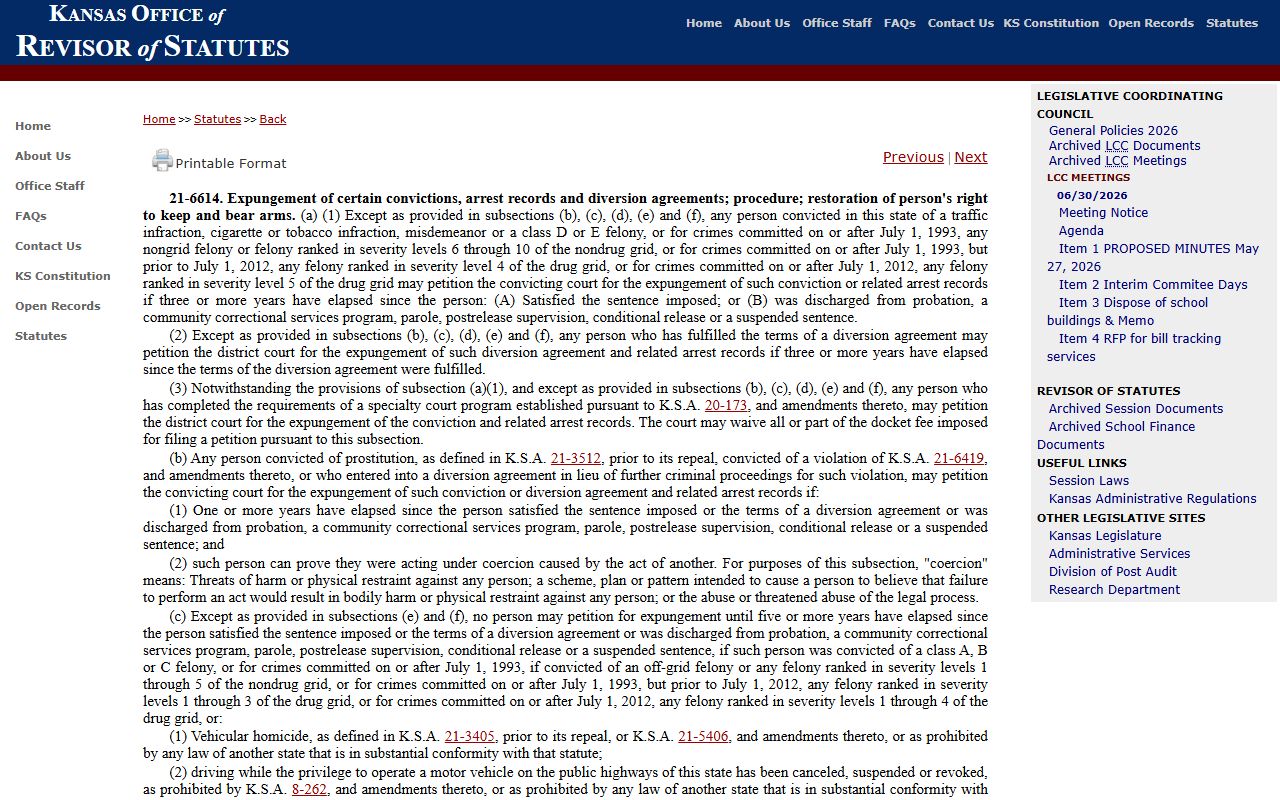
Clark County's fee chart lists conviction expungement under K.S.A. 21-6614 and arrest expungement under K.S.A. 22-2410 at a $195 total. Many eligible misdemeanors and lower-level felonies have a three-year waiting period after sentence satisfaction or discharge from supervision, while some serious or DUI-related categories require more time or are not eligible.
The expungement statute source appears in the manifest image below.
When an order is granted, the clerk sends certified copies to the Kansas Bureau of Investigation and other required agencies.